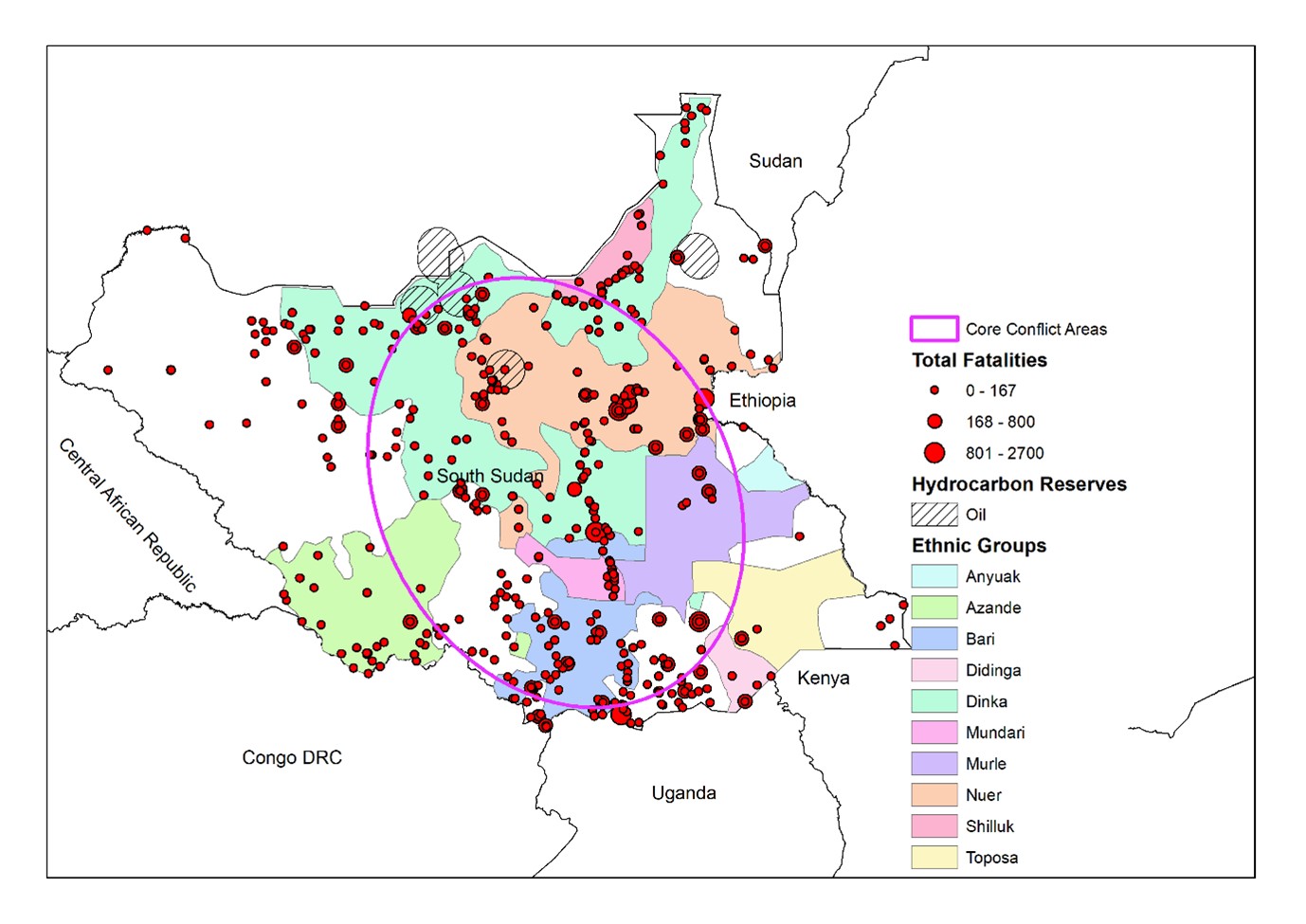
Authors: Mohammad M. Aghdam, Hamid E. Ali, and Shahjahan Bhuiyan
Journal: Defence and Peace Economics
Publication Date: September 17, 2025
DOI: https://doi.org/10.1080/10242694.2025.2561009
(This is an Open Access article, available under the Creative Commons Attribution License.)
Abstract
Our study critically explores the complex relationship between oil extraction, ethnic grievances, and the intensity of violent conflicts in oil-rich regions, with a specific focus on the Niger Delta and South Sudan. We hypothesize that the combination of oil extraction and the systematic exclusion of certain ethnic groups from national politics, coupled with inequitable distribution of oil revenues, significantly increases the likelihood of violent conflict. We introduce a rent-seeking framework to analyze how competition for oil rents can intensify existing grievances, offering a fresh perspective on how greed, grievances, and rent-seeking behaviors escalate violence in these two regions.
Methodology
Methodologically, we utilized geographic data from the PRIO-GRID dataset for our two case studies, employing negative binomial regression models to test our hypotheses. A key distinction of our study is the innovative use of the ‘best estimates of fatalities’ from the Uppsala Conflict Data Program (UCDP) Georeferenced Event Dataset (GED), shifting the focus from the onset of violence to its intensity. We also applied Moran’s I tests with Monte Carlo simulations to assess and address potential spatial autocorrelation in the data, ensuring the robustness of our findings.
Key Findings
Our analysis reveals several key findings:
- The Interaction of Oil and Exclusion: Violent conflicts are notably intensified in these oil-rich regions, primarily due to the exclusion of ethnic groups from national political dialogues. We found a significant positive interaction effect between oil production and ethnic exclusion, demonstrating that oil production amplifies the conflict-inducing potential of political marginalization.
- The Mitigating Role of Economic Development: Conversely, economic development was found to mitigate violence intensity by elevating the opportunity cost and reducing the capacity for violence.
- Contextual Differences: While an increase in development levels alongside oil revenues was associated with a reduction in conflict intensity in South Sudan, the Niger Delta showed insignificant results for this specific interaction, highlighting the importance of local context.
Conclusion and Policy Implications
These results emphasize the importance of moving beyond main-effect models to examine the interaction between resource wealth and structural inequalities. From a policy perspective, our study offers valuable insights for policymakers and practitioners. We advocate for integrated strategies that combine responsible resource governance with measures to promote inclusive political representation and equitable economic development. Targeted investments in marginalized oil-producing regions, alongside institutional reforms to reduce exclusion, are crucial steps to mitigate the risks of violent escalation.
How to Cite
Ali, H. E., Aghdam, M. M., & Bhuiyan, S. (2025). Oil extraction, grievances, and conflict: evidence from Niger Delta and South Sudan. Defence and Peace Economics. https://doi.org/10.1080/10242694.2025.2561009